
Where Is Psychedelic Research Published? The Top 10 Journals, and How We Found Them
The work of a researcher goes beyond developing research questions, collecting data and writing up results. We must also juggle keeping up with an ever-growing body of literature and deciding where to submit our own work.
Our lab has developed a workflow that has helped us not only keep up with the latest psychedelic research, but also incidentally gather data about the publishing landscape, including which journals psychedelic research papers most heavily concentrate in. We are sharing what we found, for anyone wanting a clearer picture of which journals are publishing the most work in this field. We also detail the process behind it, so that other research teams, whether their focus is psychedelics or another topic, can recreate it themselves.
Our Process
We set up an automated workflow that runs every Monday morning and looks for anything published in the past 30 days matching twelve psychedelics keywords. Every paper gets its own row in a shared spreadsheet, with the title, authors, journal, date, DOI, and a link to save it to Zotero. When the spreadsheet updates, our lab manager is notified by email and shares the latest articles with the team, along with one-click links to save them to Zotero. This process makes it easy for us to stay current on research in our field.
Over a year and a half, the spreadsheet grew into something we hadn't planned: it gave us the information we needed to create a resource for deciding where to submit our own manuscripts. We fed Claude the full spreadsheet of records collected since February 2025 and asked it to remove off-topic items, duplicates, and non-research records, classify the remaining publications by type (journal article, conference abstract, or preprint), and tally how many appeared in each journal and preprint server.
The Top Publishing Journals
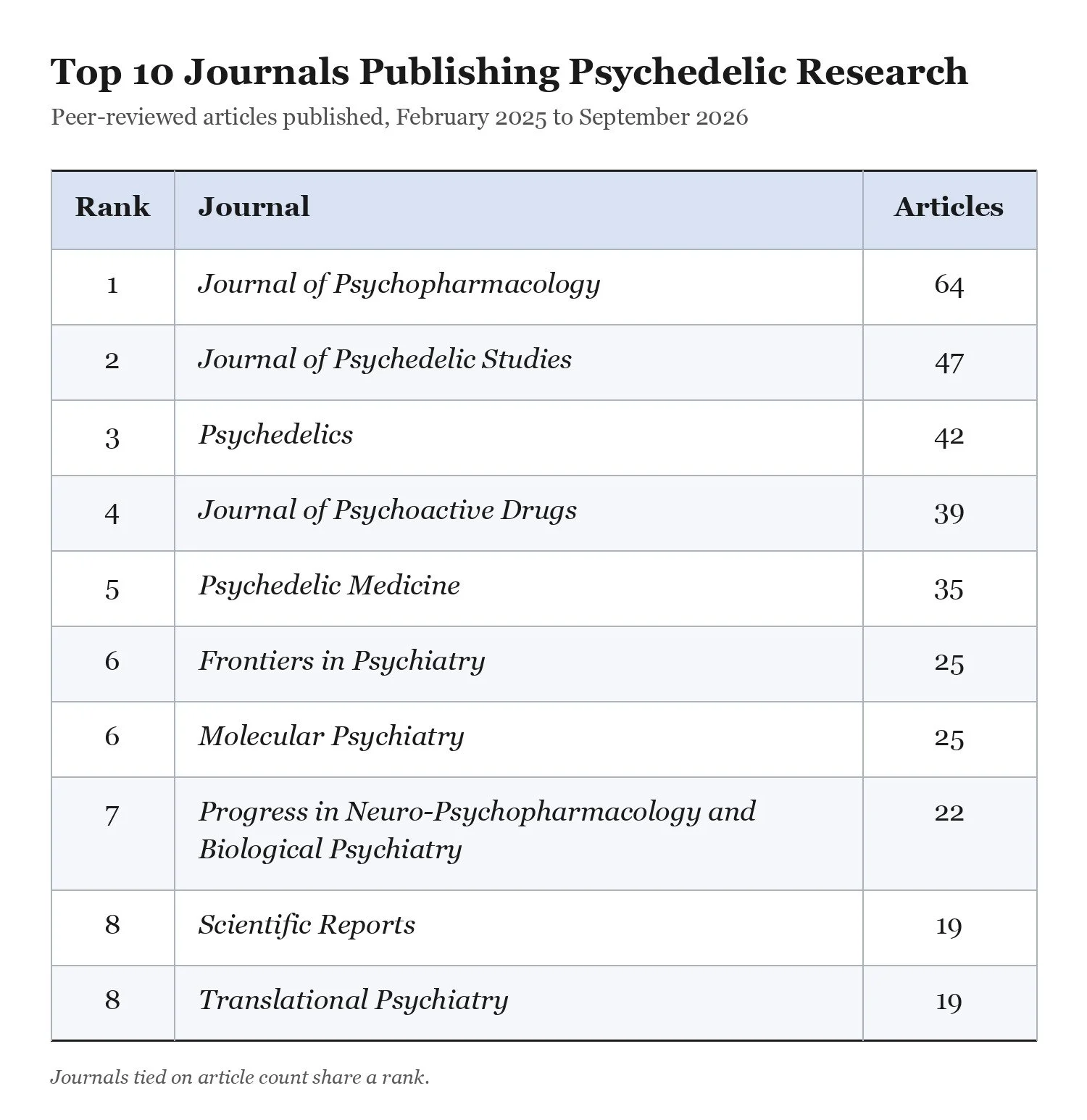
Of the 2,637 records our workflow captured between February 2025 and September 2026, 1,803 psychedelics-related publications remained after screening, spread across 588 journals and 16 preprint servers, with the top journal, Journal of Psychopharmacology, publishing 64 articles. The table below shows the top 10 journals by number of peer-reviewed articles published. If you're interested in more detail, you can download our Psychedelic Research Database, covering every journal that published two or more psychedelic research articles in that time, and much more.
Areas for Improvement & Takeaways
This data set isn't meant to be perfect. It's a tool for managing the competing demands of being a researcher, so our time and resources go toward research that meets the quality we expect of ourselves. Our keyword-driven process is inherently imperfect; "ibogaine" was not included in our original keyword list, for example, which likely limited the scope of what our workflow captured. An imperfect weekly snapshot still tells us what topics are being published on, lets us read what seems most relevant, and gives us a sense of what's out there for when we need to dig in for a project. It also shows us where research like ours is being published.
We are sharing our process and the information we gathered from it, not because we think we have perfected it, but because we believe an imperfect tool that helps researchers focus on rigor where it matters most is worth sharing.