
Which Psychedelics Show Up Most in Recent Research? Psilocybin, by a Wide Margin
If it feels like every other new psychedelics paper is about psilocybin, you're not imagining it.
Since February 2025, our lab has run an automated weekly search of OpenAlex that collects newly published psychedelic research. By September 2026, it had gathered 1,803 articles. We asked Claude to go through every title and count which of six substances each one named: psilocybin, MDMA, LSD, ayahuasca, 5-MeO-DMT, and mescaline.
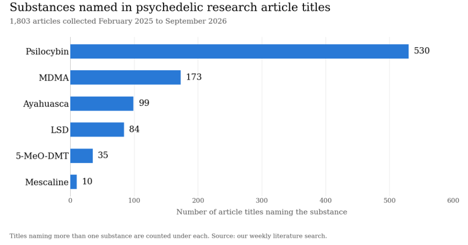
Of the 1,803 articles, 887 named at least one of these six substances in the title. Psilocybin wasn't just the most common; it wasn't close.
Substances Named in Article Titles (February 2025 to September 2026)
Psilocybin: More Than the Rest Combined
Psilocybin appears in 530 titles, three times as many as MDMA and more than the other five substances combined. Of the articles naming any of these six substances, 60% name psilocybin. Its pace also picked up: it appeared in 232 titles in 2025 and 298 in 2026, or about 22 a month in 2025 and about 35 a month so far in 2026.
That fits what we see from where we sit. Psilocybin has late-stage drug development behind it: Compass Pathways' psilocybin treatment for treatment-resistant depression has succeeded in two Phase 3 trials and is moving through FDA review. Oregon and Colorado have also built state-regulated psilocybin programs, and as an Oregon-based clinic and research center, we see much of that activity up close.
MDMA sits a distant second at 173. Ayahuasca and LSD follow at 99 and 84. 5-MeO-DMT and mescaline barely register.
Important Caveats
These are title counts, not a measure of how much research each substance gets. Plenty of studies don't name their compound in the title, which is why 916 articles named none of our six. 41 titles name more than one and are counted under each. The results also reflect our own choices. Our weekly search uses twelve keywords (psilocybin, psychedelic, ayahuasca, 5-MeO-DMT, mescaline, hallucinogen, MDMA-assisted, psychedelic-assisted, lysergic acid diethylamide, LSD-assisted, psilocybin-assisted, and MDMA), and we only counted six substances in titles. Compounds like ibogaine and DMT aren't in the chart because we didn't count them, not because no one is studying them.
This isn't a systematic review, just a snapshot of which substances we see showing up most in recent research. If you want to know more about the workflow behind it, and which journals are publishing this work, you can read about that in our previous blog post: Where is Psychedelic Research Published? The Top 10 Journals, and How We Found Them.