

New Study Finds Promising Benefits of Therapy With MDMA for Social Anxiety Disorder
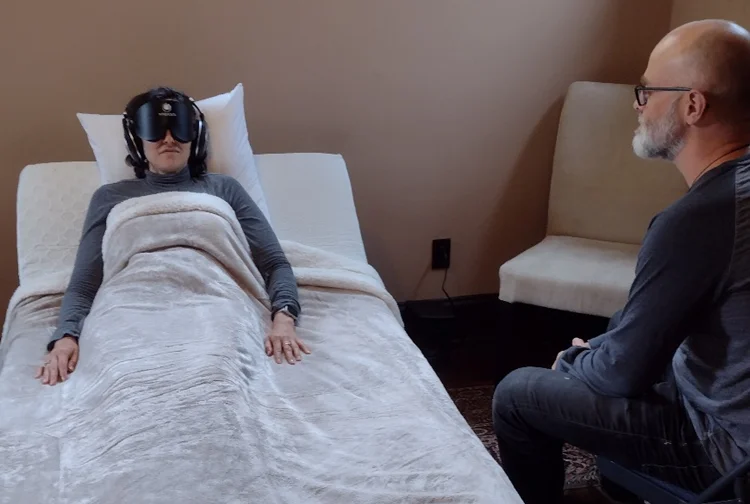
Example of what an MDMA session may look like
For people with social anxiety disorder, finding relief can be an excruciating battle. While existing recommended treatments (medications like selective serotonin reuptake inhibitors, cognitive behavioral therapy) can be beneficial, many people fall through the cracks: either not benefiting from care, or, in a tragic irony, feeling too socially anxious to start or stick with treatment.
The scientific community has been hopeful that psychedelics, like MDMA (also known as ecstasy or molly), may provide a mental health treatment breakthrough. While typically associated with parties, raves, or festivals, MDMA-assisted therapy has recently shown promise for treating serious mental health conditions, such as post-traumatic stress disorder (PTSD).
MDMA may be particularly well-suited to treat social anxiety disorder, as it can facilitate some of the very feelings that social anxiety can cloud: connection, sociability, self-compassion, warmth and ease. Despite this potential fit, only one prior study has examined the suitability of MDMA-assisted therapy for social anxiety within 12 autistic adults, finding promising preliminary evidence of safety and effectiveness.
In our team’s new study, published in the Journal of Affective Disorders, we built on this important work by studying the effects of MDMA-assisted therapy on mental health and safety outcomes in 20 adults with social anxiety disorder. Treatment involved two “dosing” or “medicine” sessions, in which participants took MDMA under the close supervision of two therapists, in our clinic in Portland, Oregon.
During dosing sessions, participants could introspect with eyeshades and music, talk with therapists, explore past memories of events that contributed to social anxiety, or do activities that stretch their social repertoire (e.g., sharing something vulnerable). Before and after dosing sessions, participants received psychotherapy sessions without MDMA. These psychotherapy sessions allow people to make the most of their MDMA experiences: to approach using MDMA safely and intentionally, then understand and make the most out of their experiences.
Participants either began treatment right away, or after a delay, allowing us to compare how mental health and wellbeing change when people receive treatment, versus when they don’t.
Results were promising: after the MDMA treatment, participants’ social anxiety levels decreased significantly.
Treatment also appeared to help other facets of life that social anxiety often affects: participants reported feeling less shame, and more self-compassion, belonging and authenticity. These benefits occurred with no serious safety concerns (e.g., increases in suicidality, dangerous medical conditions).
“I feel hopeful that this may be a possible new treatment that could really make a big difference in a lot of people’s lives who are suffering.”
— Jason Luoma, PhD (Lead Researcher and Study Therapist)

Principal Investigator, Jason Luoma, PhD
Jason Luoma, lead investigator and study therapist, described the study as “one of the most meaningful and inspiring experiences that I’ve had in my clinical career.” As someone who has conducted psychotherapy for nearly 30 years, he described how inspiring and hopeful it felt to see people benefit so quickly with MDMA-assisted therapy:
“When I’ve worked with people in ordinary talk therapy, I’ve often spent many months or even years helping people to have a stronger sense of self-compassion… Ordinary talk therapy can get to a lot of the same things, but with MDMA these changes unfolded in days or weeks rather than many months or perhaps years.”
Our study included 20 people, so our participants’ experiences may not generalize to the broader population. This is especially true for groups our trial didn’t represent well. Most participants were white, and all of them could take significant time away from their lives for a time-intensive study. They also had to clear several eligibility hurdles, such as no active suicidality and no medical conditions that could interfere with treatment.
Nonetheless, our findings are hopeful. While our study was small, it still shines a spotlight on the experiences of 20 people living with real suffering, many of whom described the treatment as deeply transformative. For some, it was the first time they were able to understand their social anxiety clearly, feel comfortable around others, or access self-compassion. As one participant explained:
“I felt empathy for myself instead of shame or ‘what’s wrong with me’.”
We have a lot more to share about this project, so we’re dedicating a full blog series to it: MDMA for Social Anxiety: Behind the Scenes of Our Clinical Trial. Over the coming weeks, we’ll explore what therapy looked like inside our trial, how our social anxiety manual evolved, how participants described their experiences, and much more. If you’re interested in following along, be sure to sign up for our newsletter, where you’ll find updates on this series, news from our lab, and the latest in psychedelic science.
You can read the full peer-reviewed study in the Journal of Affective Disorders: MDMA-assisted therapy for social anxiety disorder: A randomized, open-label, wait-list controlled trial, or read the free, publicly available preprint on PsyArXiv.
This article is for educational purposes and does not constitute medical advice. MDMA-assisted therapy is currently investigational and available only through approved clinical trials.